Securing Your Site: SSL, Backups, and More Hosting Essentials
Learn the essential hosting security features every website needs — from SSL certificates to automated backups.


Global internet bandwidth reached 2,259 Tbps in the first half of 2026 — a 23% jump from the year before (TeleGeography via Mediasat). If your website or application serves media, handles large file transfers, or supports a growing user base, a standard VPS with tight data transfer caps can become a bottleneck fast. That's where high bandwidth VPS hosting comes in.
A high bandwidth VPS gives you the same isolated server environment as a regular VPS — dedicated CPU, RAM, and storage — but with significantly more data transfer capacity. Instead of worrying about overage charges when traffic spikes, you get generous or unmetered bandwidth that keeps your services running smoothly under heavy load.
Every VPS plan includes a data transfer allowance — the total amount of data your server can send and receive per billing cycle. On a standard VPS, this might be 1–5 TB per month. A high bandwidth VPS raises that limit substantially, often to 10 TB, 50 TB, or fully unmetered transfer.
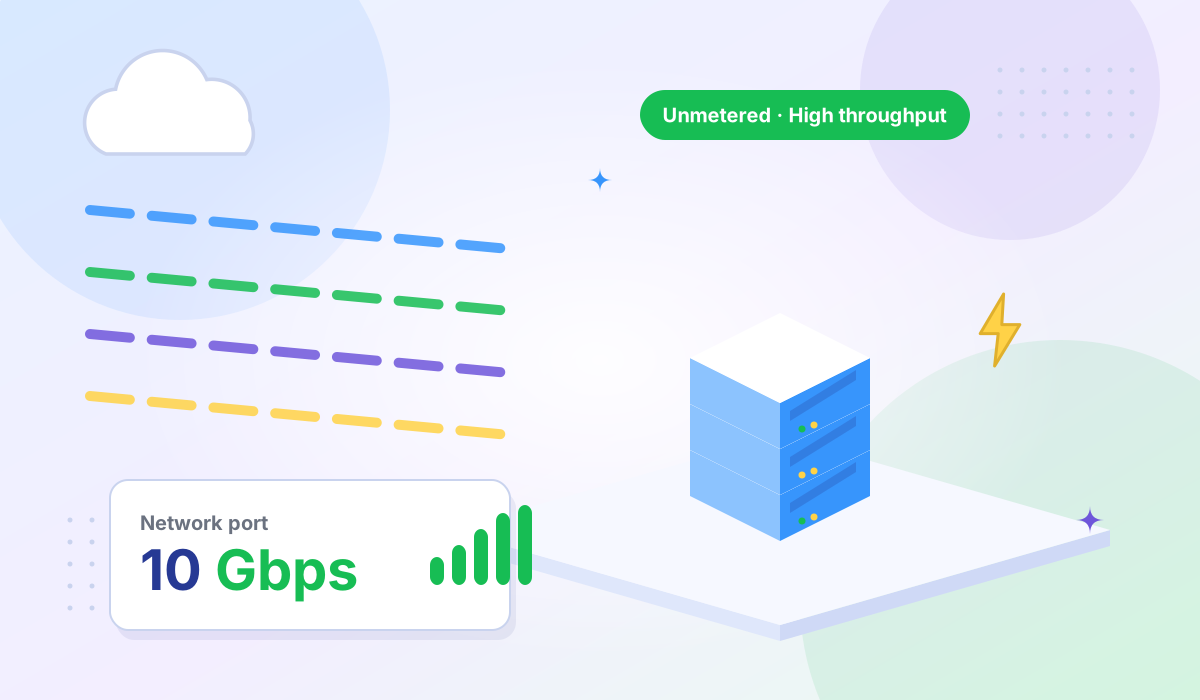
The distinction matters because bandwidth isn't the same as speed. Your port speed (typically 1 Gbps or 10 Gbps) determines how fast data moves at any given moment. Bandwidth is the total volume of data you can push through that port over a month. A server with a 1 Gbps port and a 2 TB cap can theoretically exhaust its monthly allowance in less than five hours of sustained transfer.
| Feature | Standard VPS | High Bandwidth VPS |
|---|---|---|
| Monthly data transfer | 1–5 TB | 10 TB – unmetered |
| Overage charges | Common | Rare or none |
| Port speed | 100 Mbps – 1 Gbps | 1 Gbps – 10 Gbps |
| Best for | Low-traffic sites, dev environments | Media, SaaS, file hosting, game servers |
| Cost | Lower base price | Higher base, but predictable |
Global used international bandwidth tripled between 2020 and 2024, surpassing 6.4 Pbps (TeleGeography, 2025). Content and cloud networks now account for nearly three-quarters of that demand, up from a minority share in 2016.
For server operators, this trend translates into real pressure. Websites are heavier than they were five years ago — richer media, more JavaScript, larger API payloads. If you're serving a global audience, your data transfer adds up quickly. A single 4K video stream uses roughly 7 GB per hour. A busy SaaS dashboard pulling real-time data can generate hundreds of gigabytes in API traffic per month from just a few hundred active users.
Not every project needs unmetered transfer. A personal blog, portfolio site, or small business page with a few hundred visitors per day will do fine on shared hosting or a basic VPS. But several types of workloads hit bandwidth limits regularly:
If you host video, audio, or large image galleries directly from your server, bandwidth is your primary resource constraint. Streaming platforms, podcast hosting services, and photography portfolios with high-resolution downloads all need high bandwidth to avoid buffering or failed transfers during peak traffic.
Software-as-a-service platforms generate bandwidth through API calls, webhook deliveries, file uploads and downloads, and real-time data synchronization. As your user base grows, so does the data your server moves — often faster than you'd expect. High bandwidth VPS hosting gives you room to scale without sudden cost surprises.
Multiplayer game servers handle persistent connections with many simultaneous players, each sending and receiving position updates, chat messages, and game state data. Lag caused by bandwidth throttling ruins the experience. Game server operators need consistent, high-throughput connectivity with low latency.
Open-source project mirrors, software update servers, backup repositories, and file-sharing services all involve serving large files repeatedly. A Linux distribution mirror, for example, might serve the same 4 GB ISO thousands of times per day during a release cycle.
Online stores experience dramatic traffic spikes during sales events, product launches, or seasonal peaks. Each product page loaded with high-quality images, customer reviews, and dynamic pricing data consumes bandwidth. Running out of transfer mid-sale means lost revenue. If your store handles payment data, you'll also want a provider that supports PCI DSS compliance — Tonic VPS maintains PCI DSS compliant infrastructure across all server locations.
Web developers and agencies often run dozens of client sites on a single VPS. Each site contributes to total bandwidth usage, and the cumulative transfer can easily exceed standard caps. A high bandwidth plan lets you consolidate sites without worrying about individual traffic spikes on any one domain.
Not all high bandwidth plans deliver the same value. Here's what separates a solid provider from one that just inflates the numbers on a marketing page:
At Tonic VPS, high bandwidth isn't an upsell — it's the core product. Every High Bandwidth VPS plan includes:
You can verify network performance at any of our locations before purchasing through our Looking Glass tool — run ping tests, traceroutes, and speed tests directly from each data center.
Estimating bandwidth requirements doesn't need to be complicated. Start with these three factors:
1. Average page size × daily visitors × pages per visit. If your site's average page weighs 3 MB, you get 5,000 visitors per day, and each visitor views 4 pages, that's 60 GB per day or roughly 1.8 TB per month — just from web traffic.
2. Add file downloads and API traffic. A software download page serving a 500 MB installer 200 times per day adds another 3 TB per month. API responses, webhooks, and background sync processes add more.
3. Account for traffic spikes. Your baseline is the floor, not the ceiling. Marketing campaigns, social media mentions, or seasonal traffic can triple your normal usage overnight. A good rule of thumb: choose a plan with at least 2–3× your average monthly transfer.
High bandwidth VPS fills the gap between basic hosting and dedicated infrastructure, but it has limits. If your project consistently needs more than 100 TB per month, saturates a 10 Gbps port around the clock, or requires custom hardware (specialized GPUs, large RAM configurations), a dedicated server or bare-metal solution is the better fit.
The same applies if you need full control over the network stack — custom routing, BGP sessions, or VLAN configurations. These are typically available only on dedicated hardware.
Speed (port speed or throughput) is how fast data moves at any given moment, measured in Mbps or Gbps. Bandwidth is the total amount of data transferred over a period, measured in TB per month. Think of speed as the width of a highway and bandwidth as the total number of cars that travel it in a month.
Not always. Unmetered typically means the provider doesn't count or bill by the byte, but your total throughput is limited by your port speed. Some providers also enforce fair-use policies that may throttle sustained heavy usage. Always check the specific terms.
Most providers allow plan upgrades without downtime. At Tonic VPS, you can scale your plan as your traffic grows — no migration required.
It depends on your traffic. A WordPress blog with under 1,000 daily visitors rarely needs more than a few hundred GB per month. But a WooCommerce store with product images, customer accounts, and payment processing during peak sales can easily exceed standard VPS caps.
Most VPS control panels provide real-time bandwidth monitoring. You can also use server-side tools like vnstat or iftop for granular tracking. Keep in mind that control panel figures may differ from provider-measured usage because they measure traffic at different points in the network stack.
High bandwidth VPS hosting solves a specific problem: you need more data transfer than standard VPS plans provide, but you don't need (or want to pay for) a dedicated server. It's the right choice for media-heavy sites, growing SaaS products, game servers, file distribution, and multi-site hosting setups.
The key is matching your actual workload to the right plan. Calculate your baseline transfer, factor in growth and spikes, and pick a provider that pairs generous bandwidth with solid hardware and a transparent network.
Ready to deploy? Explore Tonic VPS High Bandwidth VPS plans — KVM virtualization, NVMe storage, AMD EPYC CPUs, and 8 global locations with network performance you can verify before you buy.
More VPS hosting guides, server tutorials, and infrastructure tips from our blog.
Learn the essential hosting security features every website needs — from SSL certificates to automated backups.
Understanding the difference between NVMe and traditional SSD storage and how it impacts server performance.
How DDoS attacks target VPS servers and what protection measures keep your services online.