What Is High Bandwidth VPS and Who Needs It?
Learn what high bandwidth VPS hosting is and which workloads benefit most from unmetered data transfer.


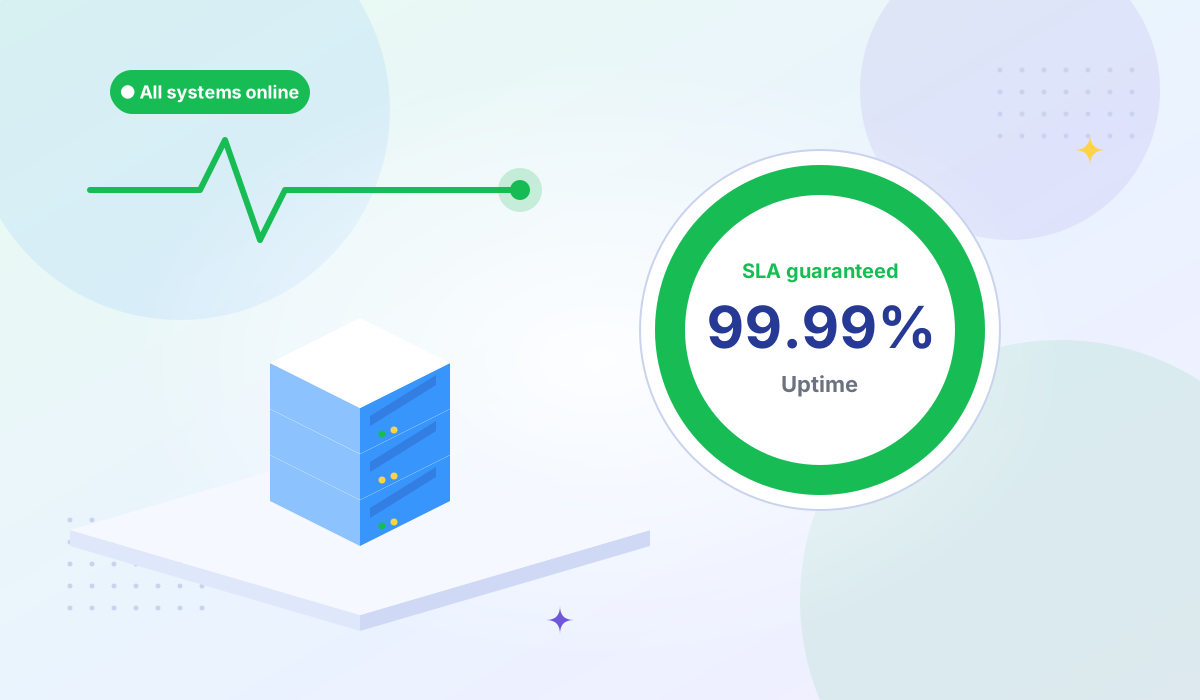
The difference between 99.9% and 99.99% uptime sounds trivial — just one decimal place. In practice, it's the difference between 8 hours and 45 minutes of downtime per year versus 52 minutes. For an e-commerce store averaging $1,000 in hourly revenue, that gap represents thousands of dollars in lost sales before you factor in customer trust and SEO impact.
Here's what uptime guarantees actually mean, what to look for beyond the headline number, and how to evaluate whether a hosting provider can deliver on its promises.
| SLA Level | Downtime per Year | Downtime per Month | Typical Use Case |
|---|---|---|---|
| 99.0% | 3 days, 15 hours | ~7.3 hours | Development, non-critical internal tools |
| 99.9% | 8 hours, 45 minutes | ~43 minutes | Business websites, blogs, standard web apps |
| 99.95% | 4 hours, 22 minutes | ~22 minutes | E-commerce, SaaS platforms |
| 99.99% | 52 minutes | ~4.3 minutes | Financial services, healthcare, mission-critical |
Downtime costs extend well beyond lost transactions:
A Service Level Agreement (SLA) defines the uptime percentage a provider commits to, along with the remedies when they fall short. But SLAs aren't the ironclad promises they appear to be:
Most SLAs offer service credits applied to future invoices — not cash refunds. If your VPS costs $50/month and the provider fails its SLA, you might get a 10–25% credit on next month's bill. Meanwhile, your business may have lost thousands in revenue.
Read the fine print. Most SLAs exclude scheduled maintenance windows, DDoS attacks, issues caused by your own software, and outages affecting services outside the provider's direct control (DNS, upstream ISP issues). These exclusions can significantly reduce the actual protection an SLA provides.
Many providers require you to file an SLA credit claim within 24–72 hours of the outage, with evidence of the downtime. If you miss the window, you forfeit the credit. External monitoring tools help here — they provide timestamped evidence automatically.
An SLA percentage is a promise. These factors determine whether the provider can deliver on it:
Enterprise-grade processors like AMD EPYC, ECC (Error-Correcting Code) memory, and NVMe SSD storage with redundancy reduce hardware failure rates. Consumer-grade components in a server chassis don't deliver enterprise reliability.
Multiple upstream ISP connections (multi-homed networking) ensure that if one network path fails, traffic routes through another. Providers with a single upstream connection have a single point of failure.
Redundant power supplies (N+1 or 2N), UPS battery backup, diesel generators, and redundant cooling systems prevent downtime from power or environmental failures. Ask about the data center's Tier classification — Tier III or higher guarantees redundant capacity components.
KVM virtualization provides hardware-level isolation, meaning a crash in one VPS doesn't cascade to others on the same physical host. Providers using container-based virtualization (like OpenVZ) have weaker isolation boundaries.
Providers with multiple data center locations let you deploy in the region closest to your users and, for critical applications, run redundant instances in different locations for disaster recovery.
Every Tonic VPS plan is built on infrastructure designed for consistent uptime:
It depends on your revenue. At 99.9%, you could experience up to 43 minutes of downtime per month. If that outage happens during a flash sale or peak shopping hours, the impact may be significant. For revenue-critical stores, aim for 99.95% or higher.
It's extremely difficult with a single server. True 99.99% availability typically requires redundancy — multiple servers behind a load balancer, failover mechanisms, and multi-region deployment. A single VPS with a reliable provider can approach 99.95%, but four nines usually requires architectural redundancy on your end.
Check the provider's status page first. If the outage is on their end, document it (screenshot timestamps from your monitoring tool) and file an SLA claim within the required window. Having a pre-configured CDN like Cloudflare can serve cached pages while your origin server is down.
Usually not. Most SLAs explicitly exclude scheduled maintenance from their uptime calculations. Check whether your provider notifies you in advance and whether maintenance windows are reasonable in duration and frequency.
Uptime isn't just a technical metric — it's directly tied to revenue, user trust, and your brand's reputation. The headline SLA percentage matters less than the infrastructure, redundancy, and transparency behind it. Evaluate providers based on hardware quality, network architecture, and how they handle failures — not just the number they print on their marketing page.
Need reliable VPS hosting? Explore Tonic VPS plans — enterprise hardware, KVM isolation, high bandwidth, and 8 global locations. Check our SLA for transparent uptime commitments.
More VPS hosting guides, server tutorials, and infrastructure tips from our blog.
Learn what high bandwidth VPS hosting is and which workloads benefit most from unmetered data transfer.
How DDoS attacks target VPS servers and what protection measures keep your services online.
Compare shared hosting, VPS, and dedicated servers side by side for traffic, budget, and performance.